

 Brochure
 Get in touch
 Apply
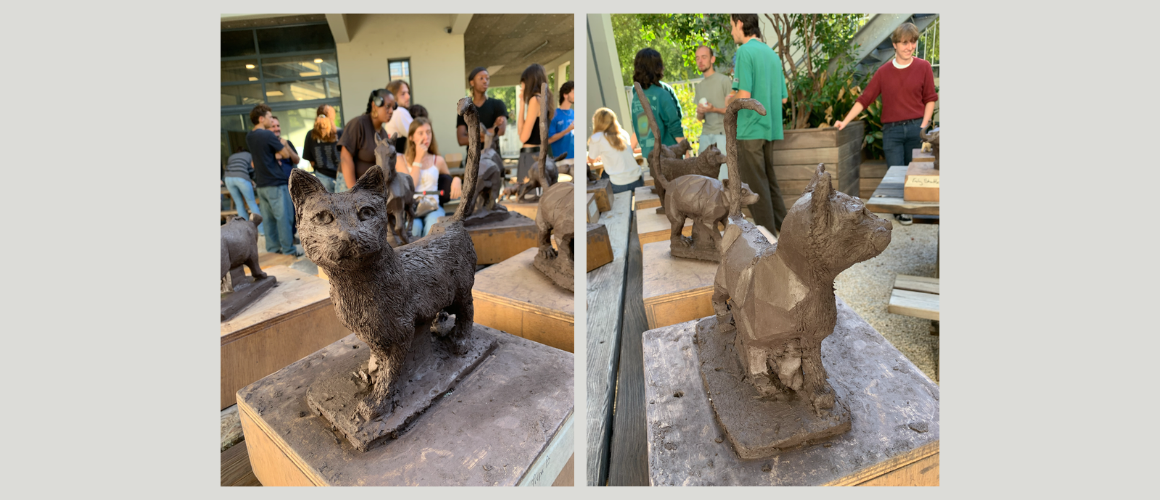
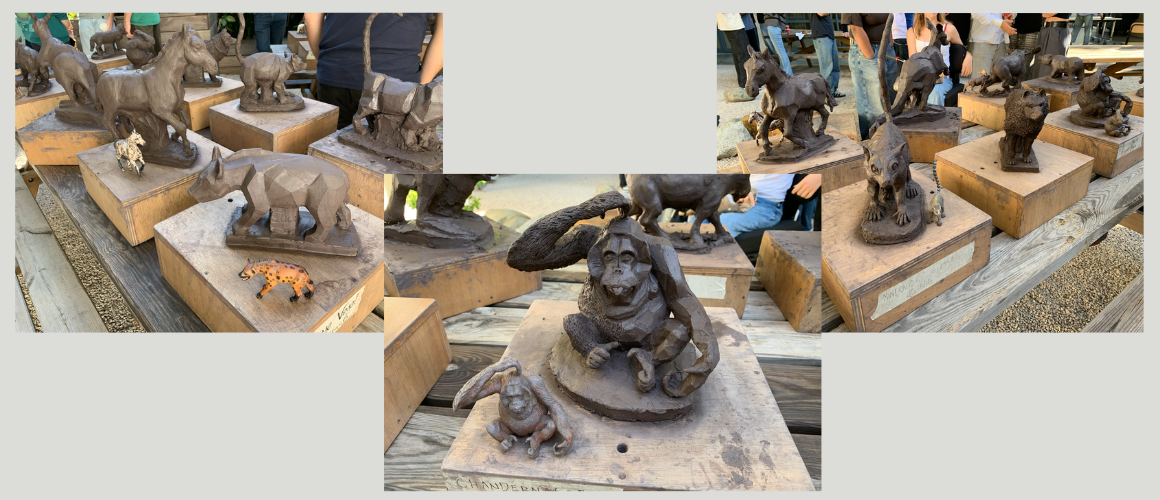
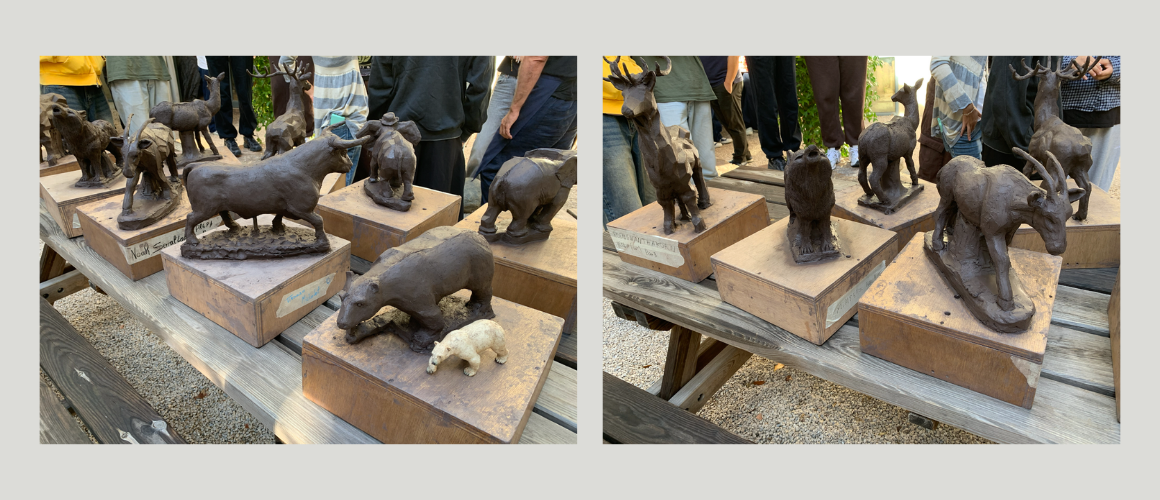
In late October 2026, students in MoPA's Preparatory Year took part in a four-day modeling workshop with sculptor Jean LEPRÊTRE. The challenge: model a realistic animal, then turn half of the sculpture into facets, in the style of artist Xavier VEILHAN. For most of them, it was their very first experience working in volume. And the results speak for themselves.
2026
Table of contents
- A modeling workshop in two stages
- Why a modeling workshop in the Preparatory Year?
- Jean LEPRÊTRE, sculptor and regular instructor at MoPA
- Xavier VEILHAN, the artist behind faceted sculptures
- MoPA's Preparatory Year
- Join MoPA
A modeling workshop in two stages
Over four days, each student chose an animal and modeled it by hand, from the first volumes to the finishing touches. Cat, wolf, rhinoceros, elephant, bear, ibex, deer, orangutan: by the end of the week, a true bestiary had settled into the school courtyard.
Step 1: modeling a realistic animal
The first part of the workshop focuses on realism. Students observe their model, understand its structure and build up the main masses: the body, the head, the legs. They then refine the proportions, the muscles, the fur or the skin.
The goal is not to "make it pretty". It is to learn how to look. Where does the animal carry its weight? How does the shoulder connect to the neck? What is the angle of a leg at rest? Each answer becomes a precise gesture in the material.
Step 2: stylizing half of the animal in facets
Once the realistic animal is finished, students turn half of the sculpture into facets. A facet is a small flat surface, as if carved. By replacing curves with planes, the form is simplified without losing what makes it recognizable.
The result is striking: on a single sculpture, a living animal and its geometric version sit side by side. One piece shows two ways of representing the same subject.
Why a modeling workshop in the Preparatory Year?
Modeling means shaping a soft material by hand to create a three-dimensional form. For students starting the Preparatory Year, it is often a complete discovery. The workshop has several learning objectives:
- Sharpening observation: reproducing a realistic animal requires looking long and carefully;
- Training the hand: the hand learns to add, remove, smooth and hollow out the material;
- Exploring unusual shapes: an animal offers a wide variety of volumes (horns, trunk, mane, thin legs, shell…), far more challenging than an everyday object;
- Understanding light: on a faceted surface, light falls plane by plane. It becomes easier to read, while still bringing the form to life;
- Taking a first step toward stylization: simplifying a real form is the foundation of character work.
Modeling, a key skill in animated filmmaking
Volume lies at the heart of animated filmmaking. In stop motion, puppets and sets are made by hand. In 3D, artists sculpt their characters on a computer using digital sculpting tools. In both cases, you need to know how to build a form that stands up, reads from every angle and catches the light.
Stylization is just as essential. Most animated film characters are not realistic: their shapes are simplified, exaggerated, deliberately chosen. Moving from realism to facets means learning to make those choices. This is exactly what students will do later in character design (the creation of characters).
Jean LEPRÊTRE, sculptor and regular instructor at MoPA
Jean LEPRÊTRE is a sculptor and artist known for his sculptures and public installations. He teaches regularly at MoPA, from the Preparatory Year through to the upper years. For example, he led a four-day modeling workshop on the theme of emotions with third-year students in the 3D Animation Cinema Program.
His approach is step by step: first gesture and handling the tools, then developing the project. This guidance helps beginners quickly gain confidence.
"I am always impressed by the results achieved by these students, for whom this is their first experience of modeling," he says.
> Discover his work on Instagram
Xavier VEILHAN, the artist behind faceted sculptures
Born in 1963, Xavier VEILHAN is a French artist who lives and works in Paris. He is best known for his polygonal faceted sculptures. Through them, he questions how we represent the world: his forms are both familiar and strange, smooth and standardized.
Animals hold an important place in his work. His Rhinocéros (1999-2000), a sculpture more than 4 meters long, is part of the Centre Pompidou collections. Xavier VEILHAN has also installed many sculptures in public spaces, such as Le Lion in Bordeaux (2004) and Le Monstre in Tours (2004). In 2017, he represented France at the Venice Biennale.
Why this reference for the workshop? Because his sculptures show that a highly simplified form can remain expressive and instantly recognizable. It is an excellent gateway to stylization.
MoPA's Preparatory Year
MoPA's Preparatory Year is a transition year between secondary school and the school's two programs: the 3D Animation Cinema Program and the Stop Motion Program. It offers a general art curriculum with a focus on animated filmmaking.
The curriculum includes:
- observational drawing and life drawing;
- graphic creation and modeling;
- color and visual arts;
- character design and screenwriting;
- art and film history;
- photography, video and an introduction to 2D animation.
Students also make two short films as a team, one in live-action video and one in stop motion. The goal: confirm their career path, build a portfolio of personal work and reach the level required to enter the first year.
Workshops like Jean LEPRÊTRE's are part of this approach: learning by doing, alongside professionals.
Join MoPA
Want to train in animated filmmaking and discover modeling, drawing and storytelling from your very first year? MoPA's Preparatory Year is made for you.
Applications are submitted online. You can also come and discover the school at our upcoming events.
