Brochure
 Get in touch
 Apply
ApplyMaking of the graduation film "Et après ?"
Discover the making of « Et après ? », the graduation film by Clémence RAFFIN, Narcisse PETIT, Adèle COLLIN, Laurianne BAUX, Blandine NGUYEN, Neil DELORY, graduates of the Class of 2025 from the 3D Animation Filmmaking program.
Clémence - Hi! We are in our 5th year at MoPA and we’re going to present the making of our graduation film. It’s the story of a trail runner who practices alpine trail running — a high-mountain race — and who falls into a crevasse, ending up trapped inside a glacier. We have two main characters. Our human character is Maïlo, the trail runner. She is very competitive and focused on breaking records. She doesn’t care about the mountain or nature at all; she’s not interested in it. She’s someone with a lot of ego, who doesn’t really look around her, and can be a bit unlikeable, to be honest.
Neil - The second character is the glacier. It is the Géant glacier in the Chamonix valley.
Clémence - It’s a very large glacier, very beautiful and majestic, and very calm. So it’s really in opposition to the other character.
Neil - Clémence, who initiated the project, had contacts with glaciologists who followed us throughout the film to ensure scientific consistency. We told them we were interested in documenting the Mer de Glace. We went directly to the Vallée Blanche to gather references on ice and textures. What do we hear? What do we feel? Because our character is trapped between the walls. Does it slide a lot? Is it even possible to hold on, or not at all?
Adèle - The message we want to convey with this film is to raise awareness and try to take action against glacier melting.
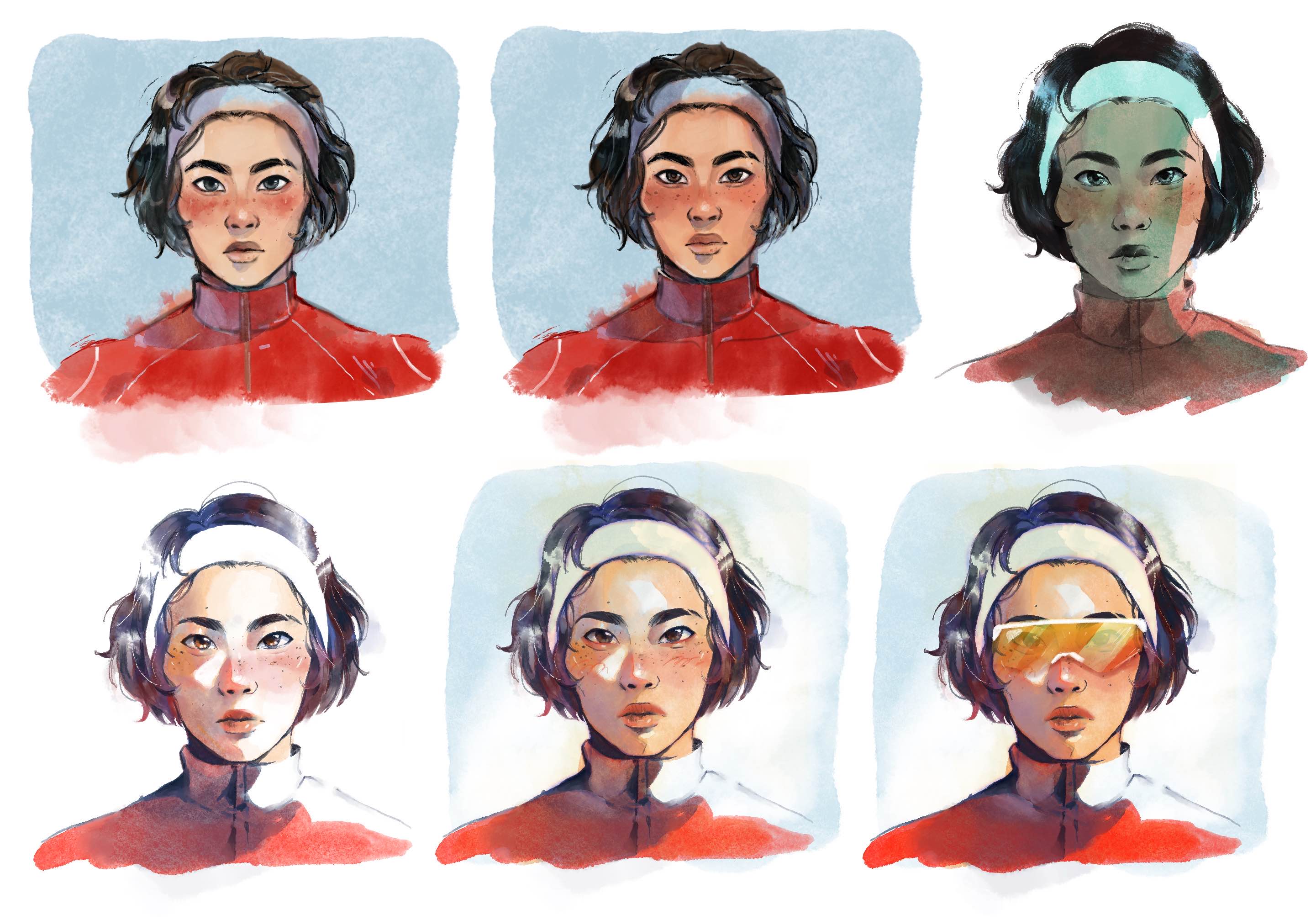
Clémence - We are a team that really enjoys mixing 2D/3D. So we decided to go with a watercolor art direction.
Adèle - Why watercolor? When mountains are depicted, it’s very often done in watercolor.
Clémence - Watercolor is made with water, and a glacier is essentially made of water. So it made sense.
Neil - We started from LiDAR scan data, since France is now almost entirely scanned using LiDAR. We were able to retrieve all the topographic data of the Chamonix valley, and then everything was repainted as matte painting in Rebelle.
Clémence - It is actually quite complicated to achieve a watercolor render that remains readable. So we did a lot of texturing work, as if we were painting with watercolor directly inside our texture software. Then we added a heavy compositing pass on top, bringing in filters and watercolor effects.
Adèle - What this graduation film brings me is the opportunity to assert myself in a field I truly enjoy and want to work in after school. It allowed me to take the time to develop an idea from scratch, and I think that’s a real chance.
Clémence - What this M5 film brought me was mainly teamwork, because it was one of the first times I had to manage people to produce a film over a one-year production. It’s quite long. The fact that our supervisors came from studios also taught me how to work properly within a production pipeline. I think it will really help me when I work in a studio later on — I already know the codes.
Adèle - For anyone who wants to study at MoPA, you need to be curious.
Neil - You need to be passionate.
Table of contents
Discover the making of the film « Et après ? »
The making of the graduation film « Et après ? » offers a behind-the-scenes look at a project created by six final-year students in the 5th year of the 3D animation filmmaking program at MoPA. This graduation film is part of a series of final-year productions that mark the culmination of a demanding and professional training program.
The project tells the story of Maïlo, a trail runner competing in a high-mountain race, whose journey takes a dramatic turn when she falls into a crevasse and becomes trapped inside a glacier. Through this making of, the students revisit the creative process, artistic choices, and technical challenges encountered throughout production.
The project was supported and documented with the help of glaciologists, ensuring a coherent and scientifically grounded representation of the natural environments featured in this 3D animation film.
A 3D animation film addressing climate issues
The film is built around a strong contrast: the living mountain environment and the immobile glacier. The main character, Maïlo, is a high-level athlete driven by performance and competition. She embodies a mindset entirely focused on her goal, at the expense of her surroundings.
In contrast, the glacier becomes a true character in its own right. Massive, silent, and majestic, it represents a stable and powerful natural force. This duality structures the entire 3D animation film and guides its narrative and visual choices.
Beyond the story, the making of highlights a reflection on nature and its transformation, with an underlying message related to glacier fragility and current climate challenges.
Opposing characters: Maïlo and the glacier
Character development was central to the construction of the film’s animation storytelling. Maïlo is portrayed as a competitive trail runner, focused on performance and largely unaware of her environment. This characterization establishes strong dramatic tension from the very beginning.
In contrast, the Géant glacier in the Chamonix valley is depicted as a calm and monumental natural space. This opposition between human and nature forms the narrative core of the project and enhances the emotional impact of the graduation film.
The students also worked on the interactions between these two entities, using field references and real-world observations to strengthen the credibility of the making of and the final render.
A 2D/3D watercolor-inspired art direction
The film’s art direction combines 2D and 3D with a strong visual inspiration drawn from watercolor painting. This choice is meaningful, as it echoes the very composition of glaciers, which are mainly made of water.
Watercolor is also a traditional technique often used to depict mountainous landscapes, reinforcing the visual coherence of this 3D animation film.
The students aimed to reproduce this effect directly within their digital workflow, with extensive texturing and compositing work to ensure both readability and artistic fidelity.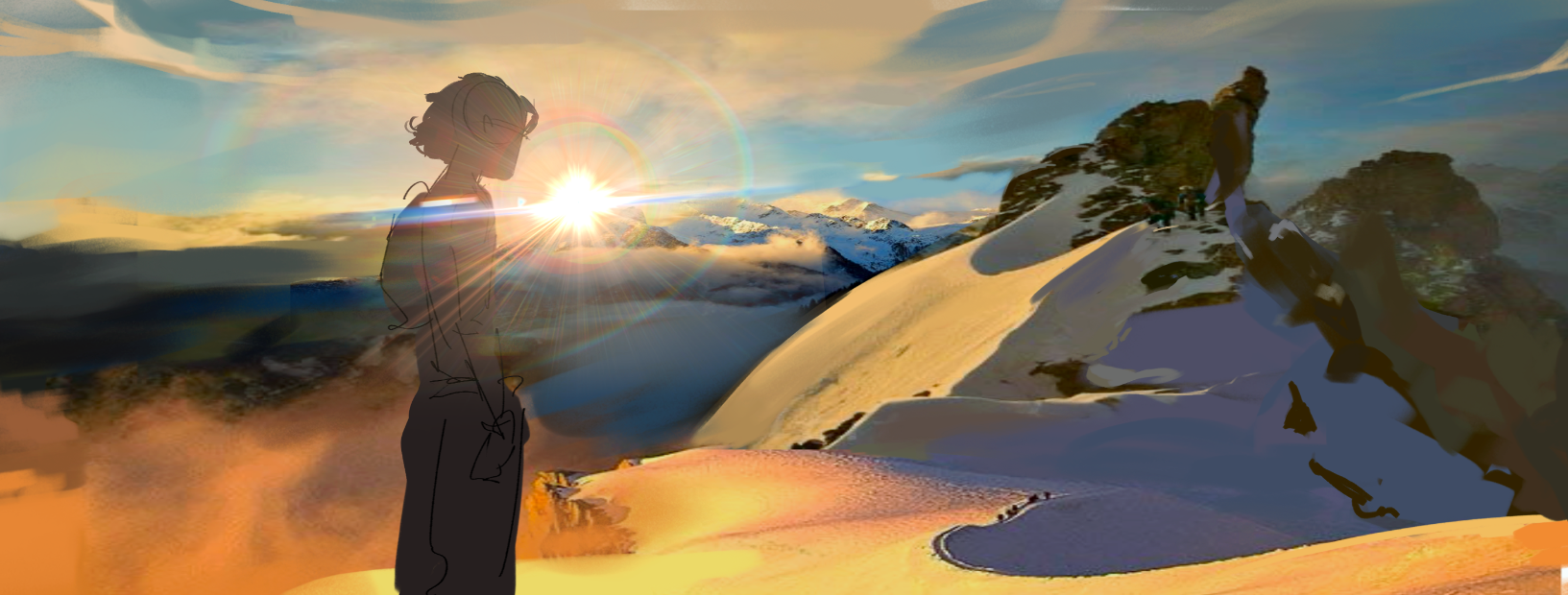
An ambitious technical production in 3D animation
The project relies on advanced production tools and techniques. The students notably used LiDAR scan data to accurately reconstruct the reliefs of the Chamonix valley.
This data was then reworked through matte painting, using specialized software such as Rebelle, to create a coherent and immersive environment.
Main technical steps of the project:
- Use of LiDAR data for topography
- Matte painting of natural environments
- Development of a watercolor style in texturing
- Advanced compositing to unify renders
- Work on the readability of volumes and materials
This making of illustrates the complexity of professional 3D animation filmmaking, where every production stage requires precision and coordination.
A formative graduation film experience
Beyond its technical dimension, this graduation film represents a strong human and professional experience. The students highlight the importance of teamwork over an extended production period, close to real studio conditions.
This project allowed them to develop essential skills for their future careers in animation filmmaking, including production management, collaboration, and integration into a professional pipeline.
Interaction with industry professionals from studios also strengthened their understanding of industry standards and expectations for a 3D animation film.
FAQ – Making of and graduation film at MoPA
What is a making of in a 3D animation film?
A making of reveals the creative process behind a film, from the initial idea to the final production. In a 3D animation film, it highlights artistic, technical, and narrative choices made by the students.
What are the challenges of a graduation film in animation?
A graduation film is a synthesis of all the skills acquired during training. It allows students to work on a complete project in a team, under conditions close to a professional studio environment.
Why is teamwork essential in a 3D animation project?
A 3D animation project requires many skills: animation, modeling, lighting, compositing. Teamwork ensures task distribution and artistic and technical consistency across the film.
The making of « Et après ? » highlights the richness of a 3D animation filmmaking project and the students’ ability to transform an idea into a complete, meaningful graduation film.