Brochure
 Get in touch
 Apply
ApplyMaking of the Graduation Film “The Left-Handed Snail”
Discover the making of “The Left-Handed Snail”, the graduation film created by Valentin DECOMBE, Matteo BOULARD, Mathys MYSIUS, Louis VELAINE, Gabryel AURY, and Clément NAHMIAS, graduates of the Class of 2025 from the 3D Animation Filmmaking program.
Matteo – Hello, we are the team behind the film The Left-Handed Snail, and we’re going to introduce you to the making-of of our film. The story follows a snail with a genetic anomaly that makes it left-handed. This means that all of its organs, including its reproductive organ, are located on its left side. Normally, in snails, they are on the right. And for snails to reproduce, they need a partner that is also right-handed, broadly speaking. So our left-handed snail goes on a quest for love in an adventure told at a snail’s scale. There was actually a scientific study that attempted to demonstrate just how rare left-handed snails are. In the species we focused on, the common garden snail, there is approximately one left-handed snail for every 30,000 individuals.
Gabryël – The film’s characters are mainly snails. There are also a few small insects and other animals. We follow Jérémy. It took some thought to give him his own identity because we see several snails throughout the film, and Jérémy needed to stand out from the rest. So both through animation and visual design, he has elements that make him distinct.
Louis – We give him expressions through his tentacles. If he lowers his head, it can convey one emotion. If he raises his body, it can express another.
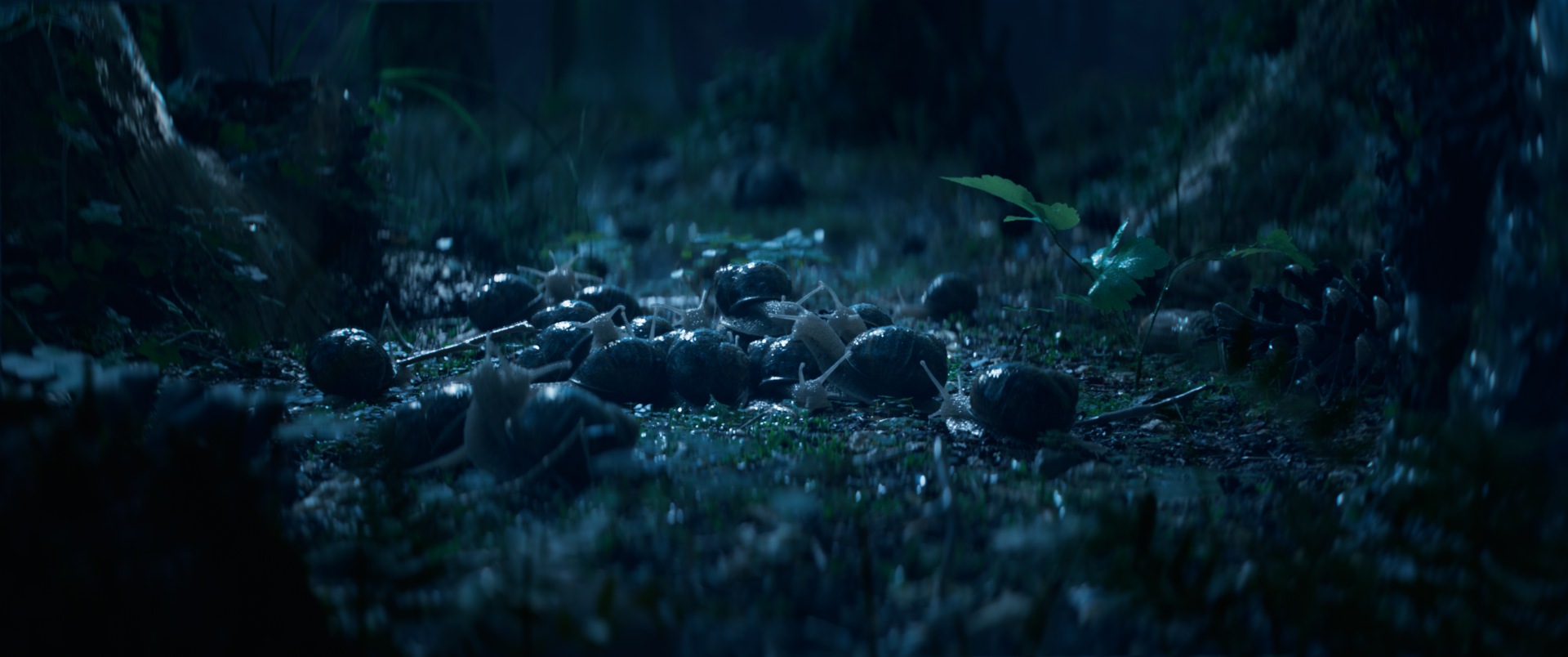
Gabryël – Since we were leaning toward a mockumentary style, we wanted everything to feel as realistic as possible. We liked the idea of bringing viewers into an environment they see every day, but at a scale they have never experienced before.
Matteo – We drew a lot of inspiration from previous MoPA student films, especially Garden Party, which was at the heart of our references. It had this garden setting with a camera placed at the scale of the characters, who were frogs.
Louis – One of the major technical challenges of the film was designing the ground surfaces, which appear at a macro scale for our snail. We had to model every object and every tiny grain of soil. Then, procedurally, we generated multiple patterns and different types of ground that could be reused throughout the film. This allowed us to automate a large part of the scene-building process.
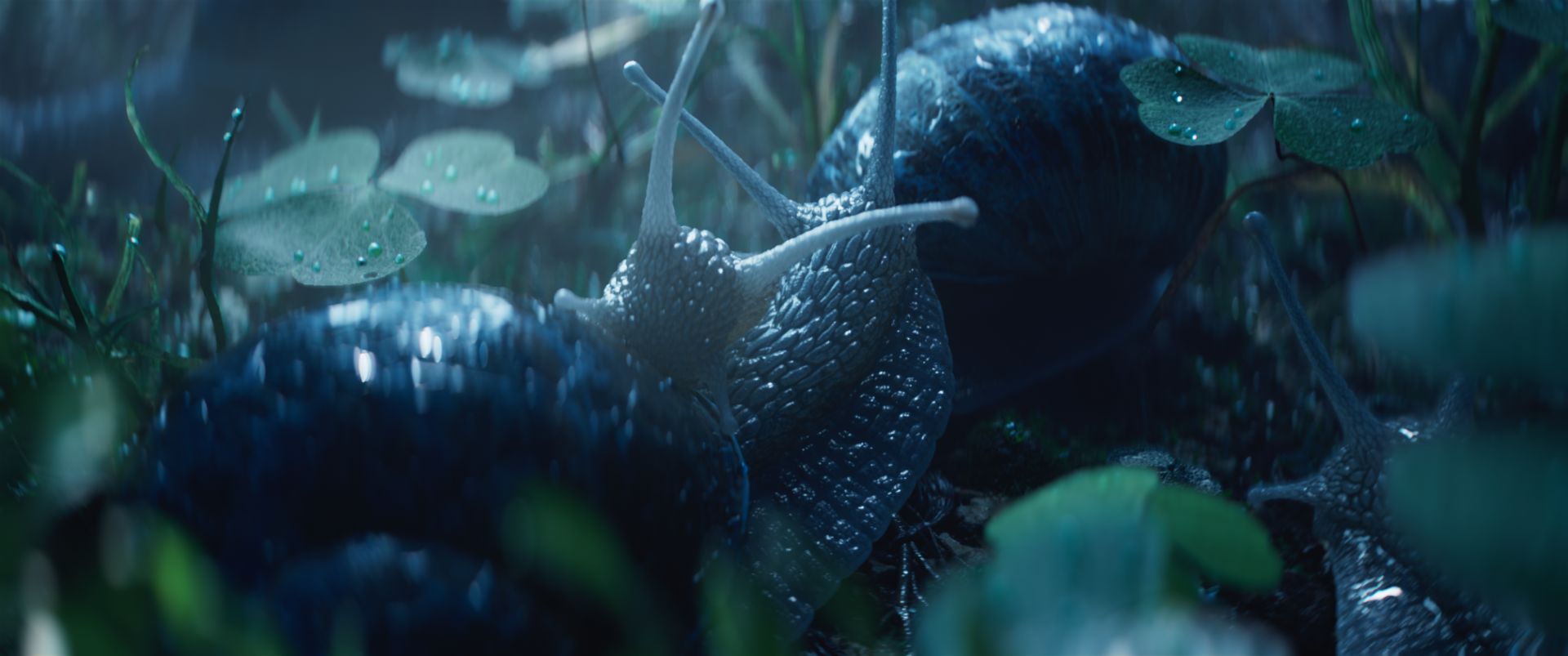
Gabryël – The snail itself was quite a challenge because it naturally has an appearance that can be a little unappealing, yet we needed to represent it faithfully on screen while still making it pleasant to watch, since audiences would follow it for five or six minutes. Its slimy, sticky, slightly translucent appearance, constantly changing depending on the angle of the light, was a real challenge. It took us time to find the right balance that would work throughout the entire film.
Matteo – Regarding the rig, the challenge was creating a soft-bodied creature using rigid elements. Bones can very quickly give a mechanical appearance, making bends and deformations visible. The goal is to soften all of that. Part of it comes from weight painting, determining how each bone influences the 3D geometry. But there are also many small tricks involved. The snail’s rig was one of the biggest technical challenges of the film. We also developed an automated wave motion on its underside. Since snails move using muscles located beneath their bodies, I implemented a system that allows animators, with just a few clicks, to generate a continuous wave across its belly to simulate locomotion.
Gabryël – Throughout the year, several industry professionals come to the school to help us with different aspects of production. They bring additional perspectives and expertise. In a way, they play a role similar to that of a lead artist in a studio, providing highly relevant feedback that helps us stay consistent with the story we want to tell, what we want to show, and ensures we keep moving in the right direction.
Matteo – Looking ahead, what we hope for this film is a successful festival run and, ideally, to become a source of inspiration just as Garden Party was for us. We would love future students to think, “If we want to create something in this style, we can draw inspiration from The Left-Handed Snail.” I think it would be a real source of pride if the film remained a reference for realism and the mockumentary genre.
Louis – My education at MoPA brought me a great deal. First of all, it helped me develop my teamwork skills because throughout the program, from the foundation year to the fifth year, we complete group projects every year. I also learned how to organize myself more effectively and work efficiently within a VFX and 3D animation pipeline.
Matteo – I found a school where there was far more listening and support than I had experienced before. Communication and collaboration were truly central, whether with fellow students, instructors, or the people supervising us. There was a constant exchange of ideas, which I believe is essential and incredibly valuable.
Louis – The advice I would give to a future MoPA student is to dedicate a lot of time to personal projects and to stay curious, especially about new technologies and software that are constantly evolving around us. This helps build a stronger technical foundation for the future, and it is something that recruiters are actively looking for.
Table of Contents
Discover the Making of “The Left-Handed Snail”
This making of takes you behind the scenes of The Left-Handed Snail, a graduation film created by fifth-year students at MoPA. Through this animated film project, the young graduates tackled numerous artistic and technical challenges to bring to life a story that is both original, humorous, and moving.
The film follows Jérémy, a snail affected by an extremely rare genetic anomaly: he is left-handed. In snails, this means that all of his organs are reversed, making it much more difficult for him to find a compatible partner. Through an adventure presented in the form of a mockumentary, the students imagined a quest for love at a snail’s scale, set in an environment inspired by the real world but viewed from a completely new perspective.
A Graduation Film Inspired by a Real-Life Phenomenon
The film’s original concept is directly inspired by a real scientific phenomenon. Among common garden snails, left-handed individuals are extremely rare: it is estimated that there is only one in every 30,000. This biological characteristic became the starting point for the entire story.
The students chose to explore this subject through the format of a wildlife mockumentary. This approach allowed them to tell a story that is both realistic and humorous while creating a strong connection with the audience.
Through Jérémy’s story, the film explores themes of difference, loneliness, and the search for connection, while remaining accessible to a wide audience.
Creating Endearing Snails in a Realistic Animated Film
One of the project’s first major challenges was character creation. Since the protagonists are mainly snails, the team needed to give them a distinct identity and clearly readable emotions without moving too far away from their natural appearance.
To differentiate Jérémy from the other snails encountered throughout the film, the team worked on both his design and his animation. His expressions are conveyed through the movement of his tentacles, the position of his body, and his overall posture.
Finding the right balance between realism and emotion is a key element of animated filmmaking. The audience must believe in the character while also developing empathy for him.
A Miniature World at a Snail’s Scale
To enhance immersion, the students chose to create an extremely realistic environment. Their goal was to depict a garden that everyone recognizes, but seen from an unusual scale.
This approach was notably inspired by Garden Party, the famous graduation film created by former MoPA students. As in that short film, the camera adopts the characters’ point of view, transforming an ordinary location into a spectacular adventure playground.
Every element of the environment was therefore designed to respect this macro-scale perspective:
- Individually modeled grains of soil
- Highly detailed vegetation
- Garden objects recreated in 3D
- Multiple procedural ground variations
- Realistic lighting and material rendering
This method allowed the team to achieve a highly believable result while optimizing the film’s production process.
Why Choose MoPA?
The production of The Left-Handed Snail perfectly illustrates MoPA’s educational approach. Throughout their studies, students work in teams on collaborative projects, allowing them to master the different stages of a professional production pipeline.
Students also benefit from the regular support of industry professionals. Their role is comparable to that of leads in an animation studio: they provide practical feedback, help solve technical challenges, and ensure the artistic consistency of each project.
This progressive immersion into professional production methods effectively prepares future graduates for the demands of the 3D animation industry.
The Technical Challenges of a 3D Animated Film
Like any ambitious 3D animated film, The Left-Handed Snail required the team to overcome several major technical challenges.
The first concerned the snail’s very appearance. The team needed to faithfully reproduce its slimy, translucent texture, which changes depending on the lighting, while maintaining a look that remained visually appealing throughout the film.
The second challenge involved the character’s animation. Unlike a human, a snail has a soft body that constantly deforms. The team therefore had to develop a dedicated rigging system capable of producing natural and fluid movements.
An automated system was also developed to reproduce the muscular waves that travel beneath a snail’s body when it moves. This innovation allowed the animators to save time while maintaining a high level of realism.
The combination of biological realism, material effects, and animation constraints made the snail one of the most complex characters in the entire film.
FAQ – Making Of and Graduation Films at MoPA
What is a making of in animated filmmaking?
A making of showcases the behind-the-scenes process of creating a film. It highlights the production stages, artistic decisions, technical challenges, and teamwork involved. In animation, it often focuses on modeling, rigging, animation, and image rendering.
Why create a graduation film as a team?
Producing an animated film requires many complementary skills. Working as a team allows students to replicate the methods used in professional studios while learning how to collaborate on an ambitious project.
What software do students use to create a 3D animated film?
Depending on the project’s needs, students use various software tools for modeling, animation, rendering, and visual effects. They also learn to work within a structured production pipeline similar to those used by major international animation studios.
What is the purpose of a graduation film at MoPA?
A graduation film allows students to showcase all the skills they have acquired during their studies. It also serves as an important portfolio piece for future career opportunities and for festival distribution.
Through this making of, MoPA students reveal the behind-the-scenes process of a project that combines technical excellence, creativity, and teamwork. The Left-Handed Snail perfectly illustrates what makes a graduation film so valuable: telling an original story while pushing the boundaries of animated filmmaking and 3D animation.
Would you like to train for a career in 3D animation and help create films recognized at festivals around the world? Apply to MoPA today!