INTERVIEW
At MoPA, students follow both theoretical and practical courses. In the 3D Animation Film program, studies are spread over five years following a preparatory year. The first cycle, from the 1st to the 3rd year, focuses on acquiring artistic fundamentals and understanding the animation film production process. The second cycle is dedicated to advanced training and professional development.
Within this framework, MoPA students complete internships in a wide range of organizations. This was the case for Amélie, who shared her experience with us.
Could you introduce yourself briefly and tell us about the organization where you completed your internship ?
My name is Amélie Baars, and I have just completed my final year at MoPA. I did my internship with the Heritage Department of the City of Arles.
Why did you choose this organization for your internship ?
I joined MoPA because I love telling stories, but above all, listening to them and discovering them. This internship immediately appealed to me because I knew I would learn more about the history of the city where I spent five years of my life.
In addition, the project focused on the Cryptoporticoes of Arles, a site that has spanned many historical periods and therefore has many stories to tell. I was eager to discover how new technologies and historical heritage could complement one another.
What was your position and what were your main responsibilities ?
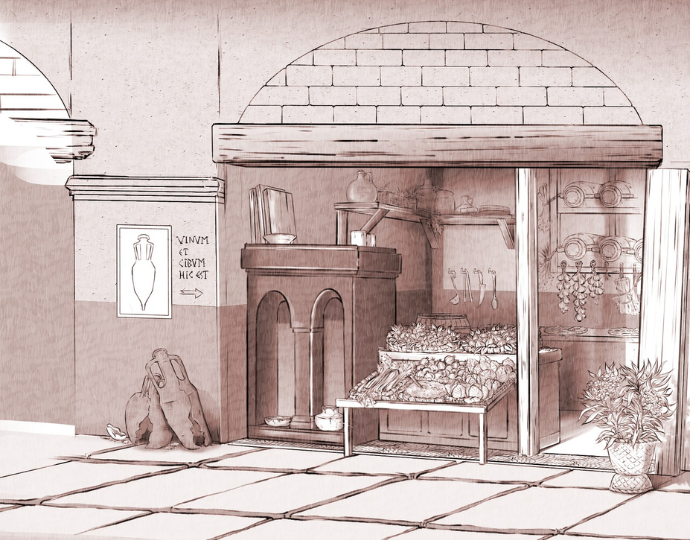
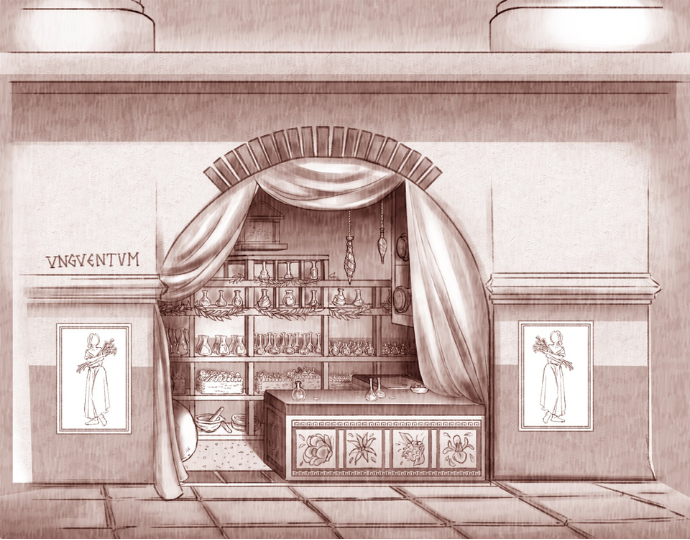
My position was 3D Animator, but I had to broaden my scope of work to successfully carry out the project. I joined at the very beginning, during the project’s “foundation phase,” which involved conducting in-depth archaeological research, producing sketches, visiting museums, and taking part in meetings with archaeologists and other professionals. We had to present our work and progress before moving on to the animation stage.
We had two main missions:
- The first was cleaning a point cloud—that is, the 3D scan of the Cryptoporticoes produced by a specialized agency.
- The second involved creating and animating characters and environments (including their textures) for the immersive visitor experience.
I joined MoPA because I love telling stories, but above all, listening to them and discovering them. This internship immediately appealed to me because I knew I would learn more about the history of the city where I spent five years of my life.
Amélie BAARS
Promotion 2026
What left the strongest impression on you in this field and in the day-to-day reality of the job ?
What struck me most was the ability to understand how people lived in a given period through research, traces, evidence, and recovered objects, as well as through similarities with other sites that suggest similar events may have taken place.
It was a constant investigation: archaeology is truly a remarkable profession. I would even say that I rediscovered archaeology. We often imagine it as a field centered on major discoveries at excavation sites, but it is above all about extensive research. You cannot deduce everything from finding an amphora somewhere—you have to ask questions to understand its journey and its impact on history. What is its shape? Was it used to transport oil, wine, or fish sauce? Is it Gallic, Roman, or African?
In this field, 3D is an essential tool, both for archaeologists and for visitors or curious minds wishing to understand our historical heritage. The ability to scan an entire monument and preserve it—along with its history—even if it were to disappear, is invaluable.
In your opinion, what are the key qualities needed to succeed in this role ?
I believe it is essential to be curious, creative, and, of course, a team player. Curious, because there was a great deal of research involved. Creative, because we had to translate research hypotheses into visuals that were accessible to a non-specialist audience, while remaining rigorous enough to avoid conveying inaccurate ideas. And finally, teamwork was crucial, as this was a collective project involving several schools and institutions that required constant communication and collaboration.
The Role of a 3D Animator
The role of a 3D animator is to bring elements of an animated film—characters, objects, and environments—to life. In 2D animation, the animator works from drawings and uses digital tools to animate them. In 3D animation, everything is created entirely on a computer using CGI and animation software.
A 3D animator has a strong overall understanding of their craft and of the different stages of the production pipeline, as well as a deep passion for animated films. They animate and manipulate 3D models created upstream by designers and artists.
What types of projects did you have the opportunity to work on ?
I had the opportunity to take part in the early stages of the project “Enhancing the Cryptoporticoes of the City of Arles through an Immersive Visit.” It was a large-scale project, presented to the public during the European Heritage Days and at the inauguration of the HUB, attended by the mayor. The project was a great success with visitors of all ages.
Which tools or software did you learn to use during your internship ?
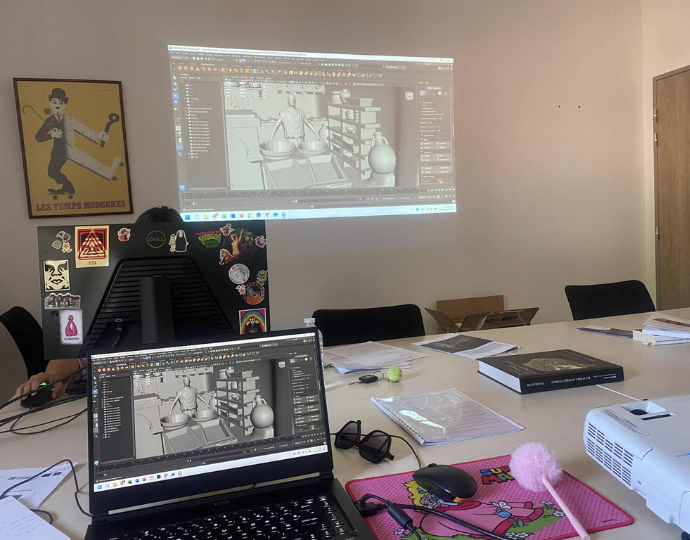
During the internship, I mainly used Maya for animation and scene layout, as well as Photoshop for sketches and research.
Did this internship allow you to develop new skills ?
This internship helped me learn how to present my ideas in front of groups and become more comfortable speaking in public. I also learned how to adapt to the sometimes lengthy process an idea must go through across different departments before receiving feedback.
From a technical perspective, I learned how to adapt my animations to the final medium.
Being able to clearly explain your ideas, regardless of the number of people present or their position, is essential. These large meetings are where issues, solutions, possible directions, and future contacts are discussed—it is how a project can move forward in a healthy way.
Understanding the reality of decision-making timelines is also important. At school, everything is immediate: classmates are nearby, and getting an answer often just means walking down a couple of flights of stairs. In a professional environment, different departments and schedules are involved, and responses can take days or even weeks. This delay must be accepted, as what feels urgent to us may not be urgent at all to the person we are contacting.
From a 3D perspective, the project was very close to video game production, as it was finalized using Unity. I therefore had to adapt my animations for real-time (and looped) use, unlike in film, where everything follows a fixed narrative and the viewer has no influence. I had to imagine how the character might interact with the visitor—it was truly fascinating.
Did this internship confirm your career choice, or did it encourage you to explore other fields ?
This internship completely confirmed my career choice, while also opening my eyes to other fields—particularly heritage and history—where 3D is clearly a powerful tool. I am also very interested in animation for video games. I love the idea of sharing an experience with the player and anticipating what they might discover.
What advice would you give to future MoPA students looking for an internship ?
My advice would be that, while an internship at an animation studio may seem like the Holy Grail, exploring other opportunities can help you develop essential soft skills and sometimes even lead you to discover a field you had never considered.
Keep in mind that this industry is very interconnected—contacts can happen quickly, even if you are not in the studio or the ideal company.
Finally, remember that an internship does not define your future (even though it can certainly help). Although the animation industry is unfortunately going through a challenging period—with limited projects compared to the growing number of 3D graduates each year—do everything you can to have a strong demo reel before your internship and continue to improve it afterward. This is only the beginning of the adventure!
Finally, what are your plans or aspirations after graduating from MoPA ?
After MoPA, I would love to continue working as a 3D animator and progress in this career by moving up the ranks, regardless of the sector. I have been offered the opportunity to start my career in Canada, and I am keeping my fingers crossed that I will be able to make it happen.
We would like to thank Amélie for sharing her valuable experience and wish her every success in the next stage of her journey—hopefully in Canada—following the completion of her degree this year.


 Brochure
 Get in touch
 Apply
Apply