

 Brochure
 Get in touch
 Apply
Making of “No Contact”: Behind the Scenes of a 3D Animation Graduation Film
Discover the making-of of “No Contact”, a graduation film by Romain MAYRAND, Florence SIMON, Corto CARRIERE, Anaëlle BOYER, Mathis LOUDJANI, Louis LEPESANT and Quentin PISAPIA, graduates of the Class of 2026 from MoPA's 3D Animation Cinema Program.
Hi, we're the team behind No Contact, and today we're going to show you our making-of! Our film, No Contact, tells the story of a couple, Jade and Noah, hiking through the desert. Tension builds because of the extreme conditions and their contrasting personalities. Everything changes when Jade ventures alone into some rocky crevices and Noah sets out to find her. The message of the film is this: it's when we're afraid of losing someone that we realize just how much they mean to us. That's the idea we developed the film around.
During preproduction, I worked on the screenplay with my classmates, particularly on developing the two characters. We had to write them as real people to make them believable and relatable. During production, I mainly focused on character anatomy and then animation, using acting references to guide the process.
During preproduction, I worked on character design, imagining what the characters would look like. Then, during production, I handled sculpting, retopology, surfacing and grooming. Basically, anything related to the characters, I was involved in.
I was responsible for modeling, texturing and creating the environments. For the film, I designed the different settings: a desert, a rocky crevice and a chasm. Some environments are incredibly vast, while others are very confined, often making the characters feel trapped and overwhelmed.
The biggest challenge was making sure the environments served the story without becoming so spectacular that they distracted viewers from the characters' emotions. We really wanted the settings to surround our characters and heighten their emotions.
Through this film, we wanted to convey several emotions. On one hand, through Jade, there's wonder and curiosity. On the other, through Noah, there's anxiety and the fear of losing someone close to him.
To achieve this, we first needed a fairly comprehensive rig, especially for the face, to convey emotions and work on lip-sync. We also brought in actors who helped us record acting references, which we then used as a foundation for the technical animation work.
We tried to portray the absence of someone through both characters. Whenever we focus on one of them, we use their emotions and behavior to show how they feel about losing their partner. And the same applies when we return to the other character.
I'd say what makes our film different is that the relationship between the characters is quite ordinary, universal, almost simple, while the environments are surprising. You never really know where you're going to end up. There's this contrast between the characters' relationship and the settings.
We're exploring a complex subject, the kind you more often find in feature films. We managed to adapt it into a shorter format for our graduation film.
A lot of that work happens during preproduction, particularly at the storyboard stage. That's when we look at the overall structure of the film and how the shots work together, one after another.
For the environments, one of our references was Bilby, a DreamWorks short film. It's set in the desert, so it was a great reference, especially for the ground textures.
We also looked at Rango for the relationship between the characters and their environments. The environments are very realistic. For the characters, we also drew inspiration from Mason's Rats, from Love, Death & Robots, particularly for its highly realistic textures. Those are the three main references that best represent our film. We also took inspiration from real places, including various rocky deserts and Antelope Canyon in Arizona, to design our crevices.
We faced two main challenges while making the film. The first was animation, because we were creating seven minutes of film with dialogue, and we only had two animators. That was a huge challenge for them. The second was the environments. We had a lot of them, so there was a great deal of preparation and setup involved.
I'd say our production process was fairly slow. The images came together quite late because we had so much organizational work to do beforehand. So the moments when we finally started seeing the finished images were particularly memorable.
In this film, physical and psychological distance plays a major role on screen. For example, one of our opening shots is enormous, with the characters appearing tiny within the landscape. There's a huge distance between them, a distance we maintain throughout the film and may finally manage to overcome in the last few shots.
The emotion we wanted to convey was the anxiety of not knowing, until the very last moment, whether our characters would find each other again. It immediately reminded me of losing your parents in a supermarket. Suddenly, the aisles turn into endless corridors stretching for miles, everything feels overwhelming, and every sound becomes a threat, even though you're just standing in the chips aisle! If the audience feels the same way I did in the supermarket when I was five years old, then I'll be happy!
What we hope for our film now is that it goes as far as possible, travels to as many festivals as it can, and leaves a lasting impression on people.
How can a 3D animated film convey the fear of losing someone you love? This is the challenge MoPA students took on with “No Contact”, a seven-minute graduation film following a couple hiking through the desert. With monumental landscapes, expressive characters and dramatic tension, this project explores human emotions through a visual adventure. In this making-of, the students take us behind the scenes of their creation, from scriptwriting to character animation. Discover how they brought this story to life and overcame the artistic and technical challenges of their graduation film.
Table of Contents
Discover the making-of of “No Contact”
Created as their graduation film at MoPA, “No Contact” tells the story of Jade and Noah, a couple hiking through a rocky desert. Extreme conditions and their contrasting personalities gradually build tension. When Jade ventures alone into rocky crevices, Noah sets out to find her.
Through this separation, the students explore a universal emotion: the fear of losing someone you love. Their goal is to show how someone's absence can change our perception of the world and reveal the strength of our feelings.
In their making-of, the students present the different stages of the film's creation: scriptwriting, character design, modeling, environment creation, rigging and animation. They also explain how their artistic and technical choices helped strengthen the emotional intensity of the story.
A 3D film about the fear of losing a loved one
With “No Contact”, the students chose to tell an intimate story set against a spectacular backdrop. The contrast between the simplicity of the romantic relationship and the vastness of the desert is one of the main creative choices behind this 3D film.
The screenplay revolves around two characters with different personalities. Jade embodies curiosity and a sense of wonder when facing the unknown, while Noah expresses anxiety and the fear of losing his partner. This contrast creates dramatic tension that accompanies viewers throughout the film. The students paid particular attention to the physical and psychological distance between the characters. Some very wide shots show them as tiny figures in the middle of the desert, emphasizing their isolation.
Preproduction played an essential role in building this narrative. From the storyboard stage, the students carefully considered the sequence of shots, framing and pacing to maintain suspense until the final scenes. Another challenge was exploring a complex emotional subject in a short format without losing the depth of the relationship between the characters.
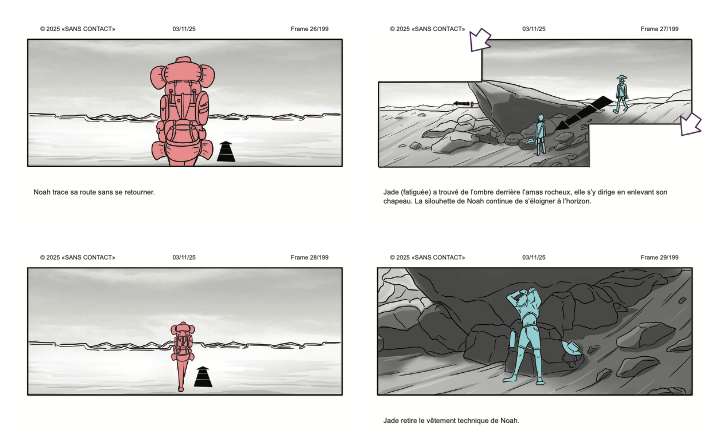
Storyboard excerpt
Expressive characters that convey emotions
In this graduation film, the believability of the characters relies as much on their writing as on their visual design and animation.
During preproduction, the students worked on character design, developing the characters' visual appearance. They then created their 3D models through several stages: digital sculpting, retopology to organize the geometry, surfacing to define the appearance of surfaces, and grooming to create hair and other fur-like elements. But the main challenge was making the characters' emotions visible on screen. To achieve this, the team developed a comprehensive facial rig, a control system that allows animators to manipulate facial expressions and synchronize lip movements with dialogue, a technique known as lip-sync.
The students also worked with actors to record acting references. These filmed performances provided a basis for studying the gestures, attitudes and expressions needed for animation. The intended result was to make viewers feel Noah's anxiety, Jade's curiosity and, above all, the sense of loss caused by their separation.
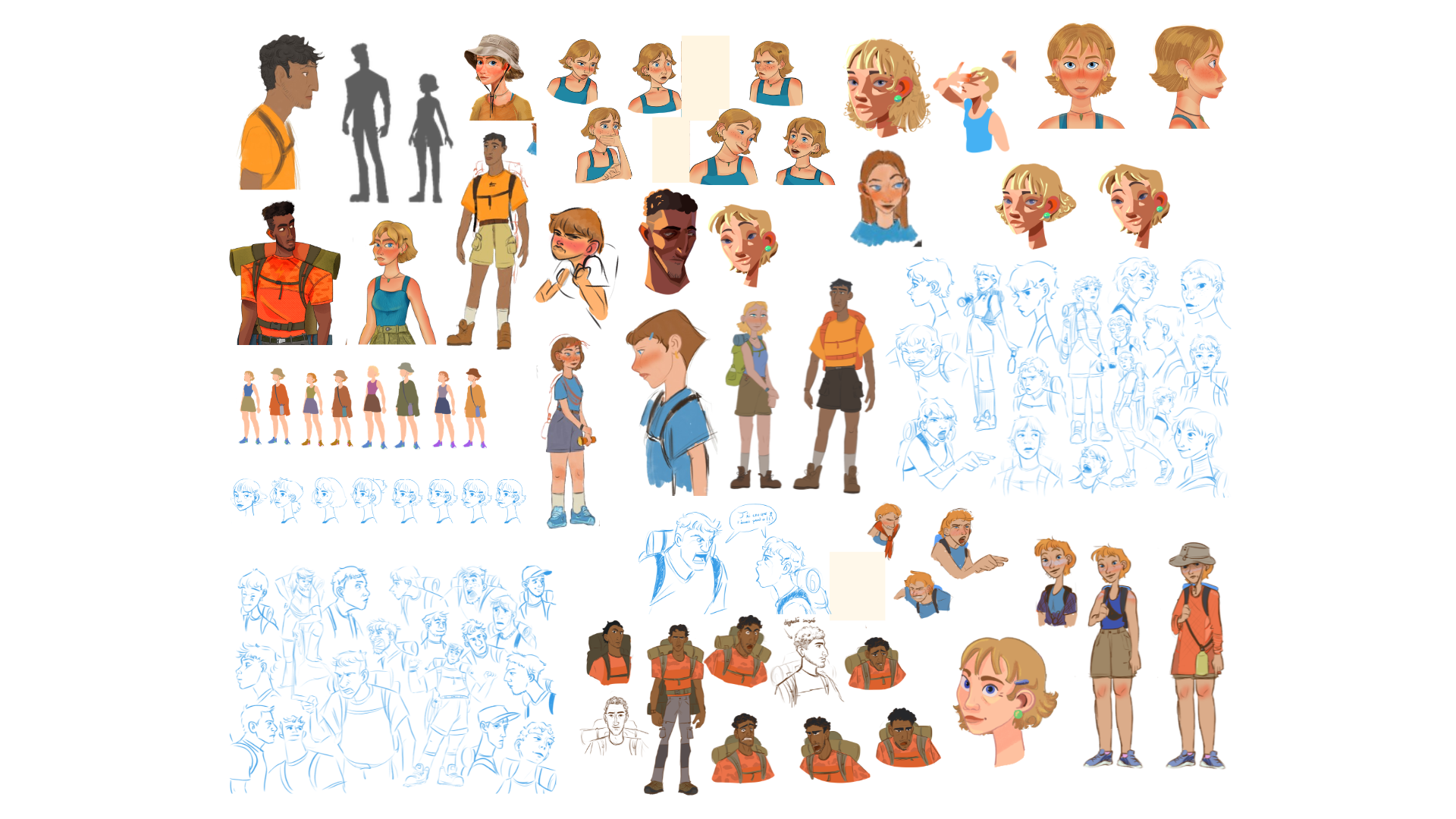
Character design sheet
3D environments that support the story
The desert plays a central role in “No Contact”. Far from being simple backgrounds, the environments directly contribute to the storytelling and the emotional development of the film.
The students imagined three main types of spaces: an open desert, rocky crevices and a chasm. These locations alternate between vast open spaces and confined areas, creating contrasting sensations for both the characters and the audience. The art direction draws on several cinematic references:
- “Bilby”, a DreamWorks short film, for its desert environments and ground textures.
- “Rango”, for the relationship between the characters and the realistic environments.
- “Mason's Rats”, an episode of the series “Love, Death & Robots”, for its realistic character textures.
- Antelope Canyon in Arizona, along with various rocky deserts, for the design of the crevices and rock formations.
One of the main challenges was creating impressive environments without distracting viewers from the story. The settings needed to support the characters' emotions rather than overshadow them. This work on volumes, textures and framing transforms the landscape into a powerful storytelling tool. The smaller the characters appear in relation to their surroundings, the more their loneliness and vulnerability become apparent.
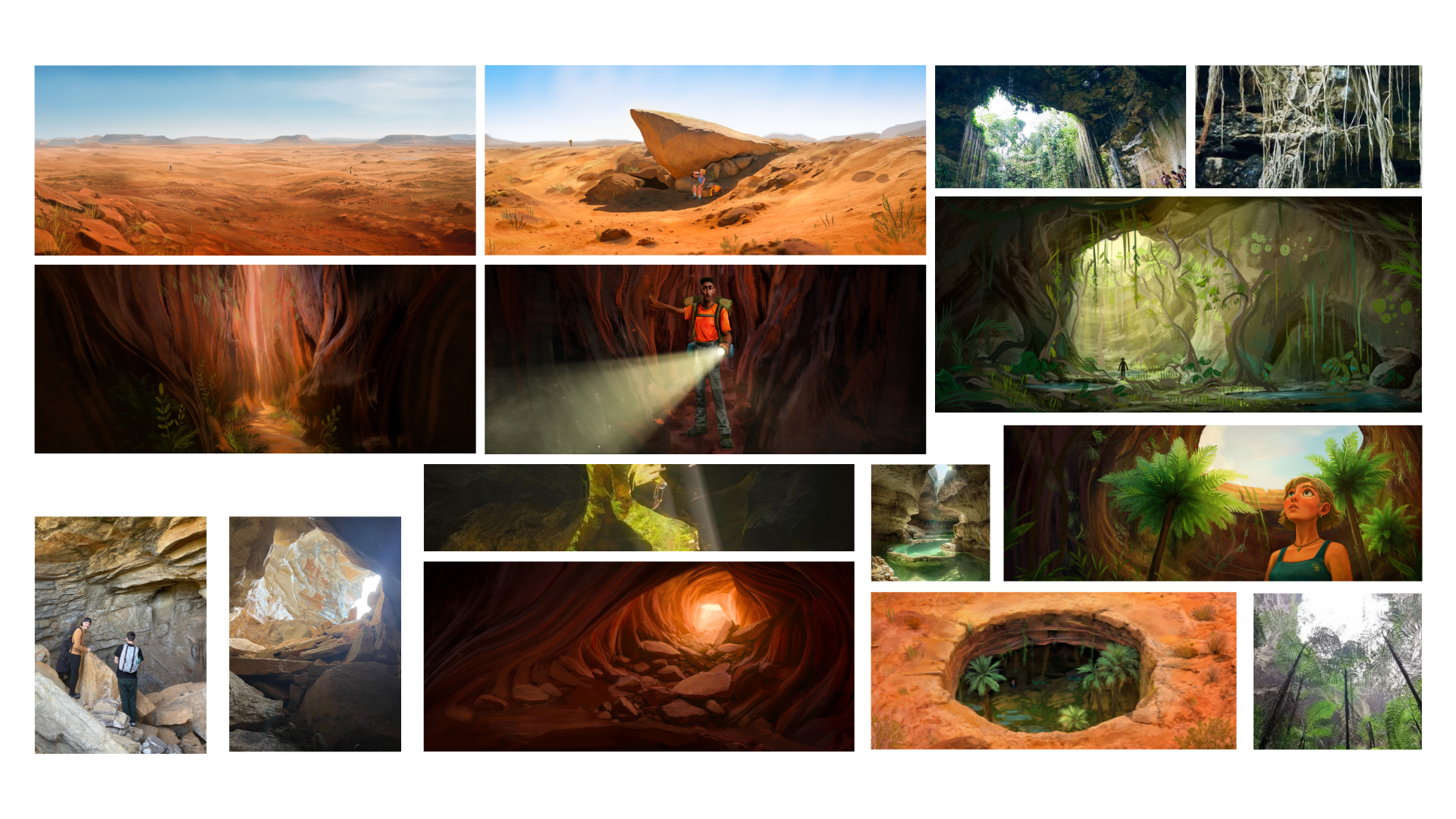
Environment concept development sheet
Key takeaways: the artistic choices behind “No Contact”
- A story centered on separation and the fear of losing a loved one.
- Two characters with contrasting personalities to build emotional tension.
- Environments inspired by real landscapes and cinematic references.
- In-depth work on facial expressions and animation to convey emotions.
The technical challenges of a 3D animation graduation film
Creating “No Contact” presented the students with two major challenges: character animation and environment creation. With seven minutes of film, dialogue and only two animators, the animation workload was particularly demanding. Every movement, expression and interaction had to serve the story while meeting production constraints.
The diversity of the environments presented another challenge. The desert, crevices and chasm required extensive modeling and texturing work, as well as coordination between the different production stages. The students explain that the project required a long planning and organization phase before the first finalized images began to emerge. These moments marked important milestones in the film's creation. This graduation film allowed them to bring together complementary skills, from writing to animation, while learning to manage the constraints of a collaborative production.
Beyond the technical aspects, the team shares one common ambition: to take “No Contact” to festivals and leave a lasting impression on audiences through its story.
FAQ – Making-of and graduation films at MoPA
What is a making-of for a 3D animated film?
A making-of takes viewers behind the scenes of a film's creation, from the initial idea to the final images. It provides insight into the team's narrative, artistic and technical choices. The making-of of “No Contact” focuses on writing, characters, environments and the animation challenges faced by MoPA students.
What is the graduation film “No Contact” about?
“No Contact” tells the story of Jade and Noah, a couple who become separated during a hike in the desert. This 3D film explores the fear of losing a loved one. The students use landscapes, framing and character expressions to convey this emotion on screen.
Which 3D animation techniques were used in “No Contact”?
The students worked on character design, modeling, surfacing, grooming, rigging and animation. They also used acting references recorded with professional actors. These techniques helped them create expressive characters and environments that support the story.
Where can I watch the graduation film “No Contact”?
The film “No Contact” is available on MoPA's official website and on YouTube. It showcases the result of the students' collaborative work and the filmmaking choices presented in their making-of.
The making-of of “No Contact” reveals how MoPA students transformed a universal story into a 3D animated film combining emotion, storytelling and technical expertise. From character development to environment creation, every stage contributes to the emotional intensity of the narrative. This graduation film also highlights the importance of teamwork in bringing an animated project to life.
Would you like to bring your own stories to life through 3D animation? Discover MoPA and train for a career in the animation film industry!
